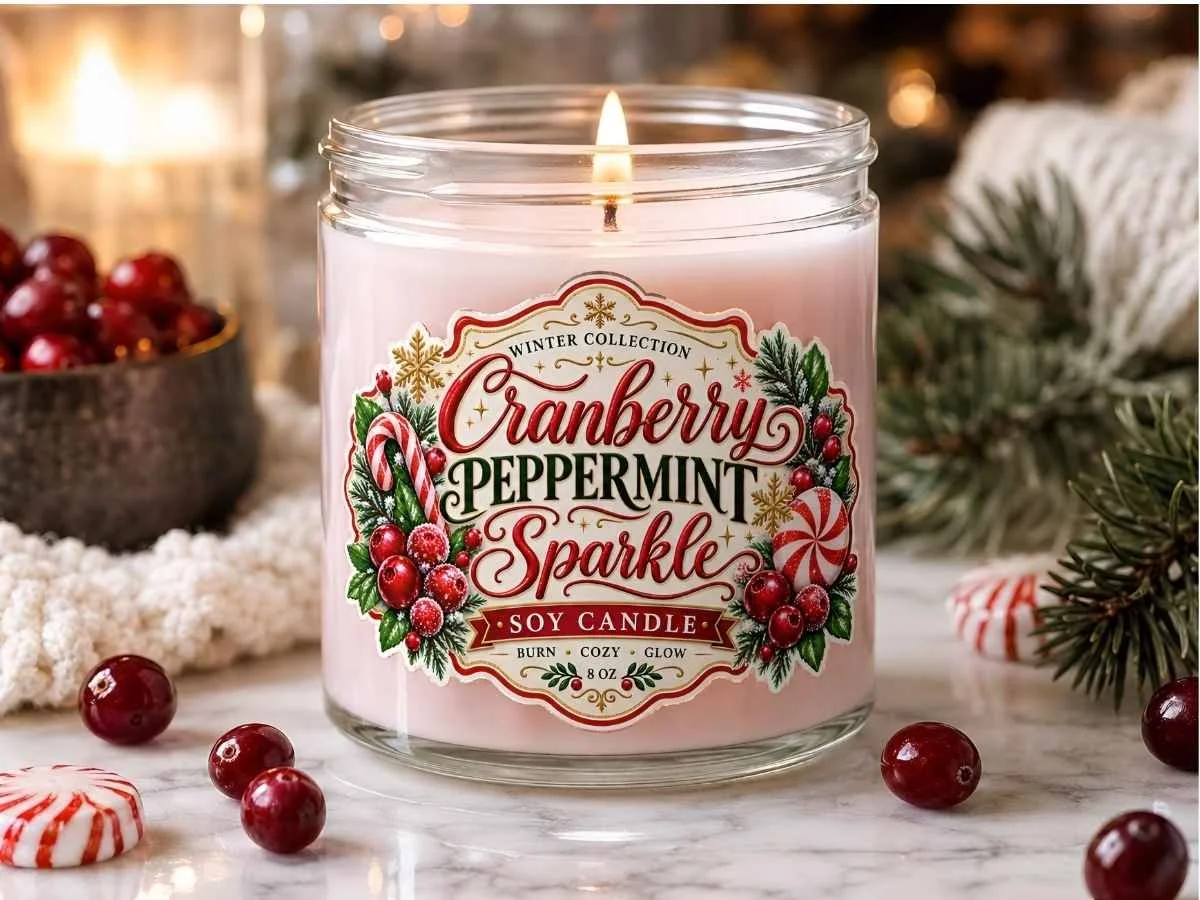
There is something about lighting a candle in winter that changes the whole room.
Cranberry Peppermint Sparkle Soy Candle brings the bright, fruity side of this winter collection into the home with tart cranberry, juicy pomegranate, a little fruity brightness, and a crisp peppermint finish.
The cranberry stays front and center.
Pomegranate gives the scent more juicy red-fruit depth.
And peppermint comes through at the end with just enough coolness to make the whole thing feel like winter.
Light it during a quiet evening, while wrapping gifts, or whenever the room could use a little winter sparkle of its own.
What You’re Making
You are making Cranberry Peppermint Sparkle Soy Candle, a container candle made with soy container wax and candle-safe cranberry, pomegranate, and peppermint fragrance oils.
The finished candle should have:
A bright fruity cold throw
Tart cranberry as the main scent
Juicy pomegranate underneath
A crisp peppermint finish
A properly tested wick
A clean, stable burn
This recipe uses 8 oz of soy container wax plus 0.48 oz of fragrance oil, giving you about 8.48 oz of finished candle mixture by weight.
Choose a candle-safe vessel that can comfortably hold the finished batch below its recommended fill line.
Do not assume a container marketed as an “8 oz jar” will automatically hold this entire recipe. Candle container names and actual wax fill weights are not always the same.
Details
Prep time: About 20–30 minutes
Cooling time: Several hours
Cure time: Follow the recommendation for your chosen soy container wax
Makes: One container candle, depending on your vessel's tested fill weight
Skill level: Beginner
Method: Soy container candle
Wax: Soy wax formulated specifically for container candles
Starting fragrance load: 6%, provided your chosen wax allows at least 6%
Scent style: Tart cranberry, juicy pomegranate, bright fruit, cool peppermint
Scent strength: Moderate
Best for: Winter and holiday home fragrance

Add a festive finish to your seasonal bath and beauty creations with the Cranberry Peppermint Sparkle DIY Label Collection. Designed to give your homemade holiday treats a polished look, this printable set is perfect for styling your personal vanity or creating sweet handmade gifts.
What’s Included
1 ZIP File containing 6 high-resolution PNG label designs
Important Details
Digital Download: Instant access to digital files only. No physical item will be shipped.
Terms of Use: Strictly for personal use only. Commercial use, resale, or distribution of the digital files or printed labels is prohibited.
Access: Your download link will be available immediately after purchase.
What You’ll Need
Digital candle scale
Candle pouring pitcher
Double boiler or candle wax melter
Candle thermometer
Candle-safe container
Candle wick suitable for your chosen soy wax
Candle-safe wick sticker or wick adhesive
Wick-centering tool
Silicone spatula or candle stirring utensil
Soy container candle wax
Candle-safe Cranberry Fragrance Oil
Candle-safe Pomegranate Fragrance Oil
Candle-safe Peppermint Fragrance Oil
Small fragrance-safe measuring container
Clean towel
Candle warning label
Label or marker
Ingredients
For one candle batch, use:
8 oz soy container candle wax, by weight
0.33 oz candle-safe Cranberry Fragrance Oil, by weight
0.10 oz candle-safe Pomegranate Fragrance Oil, by weight
0.05 oz candle-safe Peppermint Fragrance Oil, by weight
Total fragrance: 0.48 oz
For 8 oz of wax:
8 oz × 0.06 = 0.48 oz fragrance
That gives us a 6% fragrance load based on the weight of the wax.
The fragrance blend is approximately:
69% Cranberry
21% Pomegranate
10% Peppermint
Cranberry remains the strongest note.
Pomegranate gives the fragrance more juicy red-fruit depth.
Peppermint stays at the lowest percentage so it gives the candle a cool winter finish without taking over the entire scent.
Make Sure
Before you begin:
Use soy wax specifically formulated for container candles.
Follow the manufacturer's instructions for your exact wax.
Confirm that your chosen wax allows at least a 6% fragrance load before using this recipe as written.
Use a container specifically made or tested for candle use.
Check the recommended wax fill weight for your particular vessel.
Do not use drinking glasses, food jars, decorative glassware, or random containers for candle making.
Use fragrance oils specifically approved for candle making.
Check the candle-use directions supplied with each fragrance oil.
Measure both wax and fragrance by weight.
Do not measure candle fragrance with teaspoons or tablespoons.
Do not add carrier oils such as jojoba, cranberry seed oil, pomegranate seed oil, or fractionated coconut oil.
Do not add body-care ingredients to the candle.
Do not add dried cranberries.
Do not add dried peppermint leaves.
Do not add herbs, dried flowers, fruit pieces, spices, glitter, or other combustible decorations to the wax.
Do not guess your wick size.
Burn-test every wax, fragrance, wick, and vessel combination before making multiples, gifting, or selling candles.
The wax manufacturer should provide guidance for:
Melting temperature
Fragrance-add temperature
Maximum fragrance load
Recommended pouring temperature
Cure time
Suggested wick series or starting sizes
Follow the instructions for the wax you actually purchase.
Instructions
Start with a clean, dry workspace away from children, pets, drafts, and flammable materials.
Choose a candle-safe vessel that will comfortably hold approximately 8.48 oz of finished candle mixture below its recommended fill line.
Check the vessel manufacturer's actual wax-fill guidance before beginning.
Make sure your candle vessel is clean and completely dry.
Select a wick recommended as a starting point for your chosen wax and the inside diameter of your vessel.
Attach the wick securely to the center of the bottom of the container using a candle-safe wick sticker or adhesive.
Place a wick-centering tool over the vessel and secure the wick so it stays straight and centered.
Place your candle pouring pitcher on the scale and tare the scale to zero.
Measure 8 oz soy container wax by weight.
Melt the wax according to the temperature instructions supplied by the wax manufacturer.
While the wax melts, prepare your fragrance.
Place a small fragrance-safe container on your scale and tare it to zero.
Weigh:
0.33 oz Cranberry Fragrance Oil
0.10 oz Pomegranate Fragrance Oil
0.05 oz Peppermint Fragrance Oil
Confirm that the fragrance mixture weighs 0.48 oz total.
Once the wax reaches the manufacturer's recommended fragrance-add temperature, add the fragrance mixture.
Stir slowly and thoroughly so the fragrance is distributed evenly throughout the melted wax.
Follow any specific mixing directions provided by your wax manufacturer.
Allow the scented wax to cool to the pouring temperature recommended for your exact wax.
Slowly pour the wax into your prepared candle-safe vessel.
Stop at the vessel's appropriate fill line.
Make sure the wick remains straight and centered.
Leave the candle undisturbed at room temperature while it cools.
Keep it away from drafts while it sets.
Do not place the freshly poured candle in the refrigerator or freezer to rush the cooling process unless your wax manufacturer specifically directs you to do so.
Once the wax is completely solid and cool, remove the wick-centering tool.
Trim the wick to approximately 1/4 inch.
Add your candle label and appropriate candle warning label.
Allow the candle to cure for the amount of time recommended for your chosen soy container wax.
Once the candle has cured, begin your burn testing.
And there she is.
Bright cranberry, juicy pomegranate, and a little peppermint chill ready to glow.
How to Use It
Before each burn:
Trim the wick to approximately 1/4 inch.
Remove wick trimmings and other debris from the wax.
Place the candle on a stable, heat-resistant surface.
Keep it away from drafts.
Keep it away from curtains, bedding, paper, books, and other flammable materials.
While the candle is burning:
Never leave it unattended.
Keep it where you can see it.
Keep it away from children and pets.
Do not move the candle while the wax is liquid.
Keep the wax pool free from debris.
Extinguish the candle if the flame becomes unusually large, smoky, or unstable.
Follow the recommended maximum burn time for your candle and vessel.
Stop burning a container candle when approximately 1/2 inch of wax remains at the bottom.
Never burn a candle all the way down to the base of the vessel.
Parlor Scent Lab Notes
The candle version of Cranberry Peppermint Sparkle should still feel connected to the rest of our winter collection, but candle fragrance behaves differently from fragrance on the skin.
Our starting scent ratio is:
69% Cranberry
21% Pomegranate
10% Peppermint
The fragrance should open with cranberry.
Pomegranate sits underneath and gives it more juicy red-fruit character.
Peppermint comes through at the finish.
We want:
Tart cranberry + juicy pomegranate + cool winter freshness.
We do not want:
Peppermint candle with cranberry somewhere in the background.
A few more Parlor notes:
Cranberry Fragrance Oil should remain the strongest part of the scent.
Pomegranate Fragrance Oil gives the cranberry more depth.
Peppermint Fragrance Oil is strong, so it only needs a small share of the blend.
Different fragrance suppliers formulate their scents differently.
One Cranberry Fragrance Oil may smell sweeter, tarter, fruitier, or more citrusy than another.
The same is true for pomegranate and peppermint.
Make one test candle first before making several.
Judge the fragrance after the candle has had its proper cure time.
Judge wick performance over repeated burn tests rather than one lighting.
If you want to adjust the fragrance ratio, change it in the next test batch.
Never pour extra fragrance oil onto a finished candle.
The fragrance ratio in this recipe is a starting scent design.
Your nose and your burn tests get the final vote.
Why We’re Starting at 6% Fragrance
A common starting fragrance load for container candles is about 6% of the wax weight.
For this recipe:
8 oz wax × 6% = 0.48 oz fragrance
But that does not mean every soy wax can automatically be used the same way.
Before making the candle, check the maximum fragrance load listed for your specific soy container wax.
If your wax manufacturer recommends a lower amount, follow the lower amount and recalculate the fragrance blend proportionally.
Using more fragrance does not automatically create better scent throw.
Too much fragrance can contribute to problems such as:
Fragrance oil sweating
Poor fragrance incorporation
Wick problems
Poor combustion
Excess soot
Unstable flames
Poor candle performance
Start reasonably.
Cure the candle.
Burn-test it.
Then adjust the next batch if necessary.
About the Wick
There is intentionally no exact wick size in this recipe.
The proper wick depends on:
The soy wax you choose
The inside diameter of your vessel
Your fragrance oils
Your fragrance percentage
Whether you use dye
The wick series
The overall candle design
Start with the wick recommendation supplied for your chosen wax and vessel diameter.
Then test.
A wick that is too small may:
Tunnel
Produce a weak flame
Struggle to create an adequate melt pool
Extinguish itself
A wick that is too large may:
Produce an oversized flame
Smoke
Create soot
Create an excessively deep melt pool
Cause the vessel to become too hot
The number printed on the jar does not determine the wick.
Vessel diameter and the complete candle formula matter.
Burn Testing
Burn testing is part of making the candle.
It is not an optional extra.
Once your candle has completed the recommended cure time, prepare for your first test burn.
Before lighting:
Trim the wick to approximately 1/4 inch.
Place the candle on a heat-resistant surface.
Keep it away from drafts.
Record the wax you used.
Record the vessel.
Record the vessel's inside diameter.
Record the wick series and size.
Record the fragrance blend.
Record the 6% fragrance load.
During your test burns, watch:
Flame height
Flame stability
Smoking
Soot
Wick mushrooming
Melt-pool development
Container temperature
Tunneling
Hot fragrance throw
Do not judge the wick only by the first burn.
The way a container candle burns can change as the flame moves farther down into the vessel and more heat is retained.
Continue testing through the candle's full usable life.
If you notice:
An excessively large flame
Heavy soot
Persistent smoking
An excessively deep melt pool
Dangerous vessel heat
A cracked vessel
Another concerning burn behavior
extinguish the candle and stop the test.
Adjust the formula or wick in the next test candle.
Cure Time
There is no single cure time that applies to every soy container wax.
Follow the recommendation supplied with the wax you purchase.
Some soy waxes need more curing time than others before their fragrance performance can be judged properly.
The scent you notice while the candle is sitting unlit is the cold throw.
The scent you notice while the candle burns is the hot throw.
They are not always the same.
A candle may smell lovely shortly after pouring but perform differently after its full cure.
Give your wax the time its manufacturer recommends before deciding whether the fragrance blend needs adjustment.
Storage and Safety
Store your finished candle:
In a cool, dry place
Away from direct sunlight
Away from excessive heat
With a lid on when possible
Away from children and pets
Before every burn:
Trim the wick to approximately 1/4 inch.
Remove loose wick pieces and debris from the wax.
Place the candle on a stable, heat-resistant surface.
When burning:
Never leave the candle unattended.
Keep it away from drafts.
Keep it away from flammable materials.
Keep children and pets away.
Keep the wax pool clean.
Do not touch or move the candle while the wax is liquid.
Do not use water to extinguish the candle.
Allow the candle and vessel to cool completely before moving them.
Stop burning the candle when approximately 1/2 inch of wax remains.
Do not continue using the candle if the vessel becomes:
Cracked
Chipped
Damaged
Unusually hot
If the candle repeatedly produces:
A very large flame
Excessive soot
Persistent smoke
An unstable flame
Extreme vessel heat
stop using it and reassess the wick and formula.
If you plan to sell candles, proper full-life burn testing, wick testing, vessel testing, batch records, warning labels, manufacturing procedures, and applicable candle safety standards become part of the process.
A candle can be pretty.
It can smell wonderful.
But it still has to burn safely.
One Last Little Glow
Cranberry Peppermint Sparkle
This candle lets our winter scent move into the room with bright cranberry, juicy pomegranate, and that little peppermint finish glowing away in the background.
Make the candle.
Give it the cure time it needs.
Test the wick.
Then light it safely and enjoy the glow.
A little cranberry. A little peppermint. A whole lot of winter atmosphere.
Before You Leave the Parlor…
Now we have to know: when you make a winter candle, which moment are you really making it for?
Is it the candle you light during a long bath, the one glowing while you wrap gifts, or the one that stays lit while you settle in for a cozy night at home?
And for Cranberry Peppermint Sparkle specifically, would you want the cranberry to stay extra tart and bright, or would you make your next test candle a little more peppermint-forward?
Tell us in the comments. We want to know what the Parlorlettes would have glowing in their winter candle jars. 💕
FAQs
Why do I need a scale for this recipe?
Candle fragrance loads are calculated by weight.
For this recipe, 8 oz of wax at a 6% fragrance load requires 0.48 oz of fragrance oil.
Using a scale makes the formula much more accurate and repeatable than measuring candle fragrance with teaspoons.
Why isn't an exact wick size included?
Because the correct wick depends on the wax, vessel diameter, fragrance blend, fragrance load, dye, wick series, and overall candle formula.
Use the recommendations for your chosen wax and container diameter as a starting point and confirm the final wick through burn testing.
Can I decorate the candle with dried cranberries, peppermint leaves, flowers, or glitter?
No.
Keep dried fruit, herbs, flowers, leaves, glitter, and other combustible decorations out of the candle wax.
Loose material can move toward the wick, interfere with the flame, clog the wick, or create a fire hazard.
For this candle, keep the inside of the vessel simple: wax, wick, and candle-safe fragrance.
How long should I cure the candle before burning it?
Follow the cure-time recommendation for the specific soy container wax you purchase.
There is no universal cure time for every soy wax.
Waiting for the recommended cure period gives you a better opportunity to evaluate the candle's final hot fragrance throw and overall performance.
