
Have you ever noticed that your perfume seems to disappear from your skin, yet its beautiful fragrance remains on your favorite sweater or scarf? There's an interesting reason why fabric can hold onto perfume longer—and understanding it may change how you wear your favorite scents.
You spray on your favorite perfume before leaving the house.
Perhaps it's a romantic floral with delicate rose petals, a warm vanilla that feels like a soft embrace, or an elegant fragrance with just a whisper of musk.
You enjoy that first beautiful impression and go about your day.
By late afternoon, the fragrance on your wrists has become so faint that you can barely smell it.
But the next morning, something rather lovely happens.
You reach for the sweater you wore yesterday, and there it is.
A beautiful little trace of your perfume.
The same fragrance that seemed to disappear from your skin is still lingering on your clothing.
How is that possible?
And why does your sweater sometimes seem better at holding fragrance than your skin?
The answer has to do with how perfume molecules interact with different surfaces.
Perfume often lasts longer on clothing because fabric fibers can retain fragrance materials and release them gradually. Clothing also doesn't experience the same continuous body warmth, washing, or direct skin conditions that can influence how a fragrance evaporates.
But not every fabric holds perfume equally well, and spraying fragrance directly onto clothing isn't always a good idea.
Let's explore what recent research tells us about perfume on fabric, why certain materials retain scent differently, and how to enjoy that lingering fragrance without damaging your favorite clothes.
Why Fabric Can Hold Perfume Longer Than Skin
One of the most interesting things about perfume is that its behavior depends partly on where you apply it.
Your skin and your clothing are very different surfaces.
Skin is living tissue with moisture, oils, and a temperature influenced by your body.
Clothing is made from fibers with their own chemical properties, textures, and structures.
Those differences affect how fragrance materials are retained and released.
1. Fabric Fibers Can Retain Fragrance Molecules
When you spray perfume onto clothing, some of its aromatic materials settle onto the fabric.
Depending on the fragrance and textile, molecules may remain on the fiber surfaces or move into the material.
Scientists use the term sorption to describe the accumulation of substances on or within another material.
Some fragrance molecules interact more strongly with certain fibers than others.
Those interactions can delay their return to the surrounding air, allowing traces of fragrance to remain after the initial scent has become weaker.
A 2025 study published in the Journal of Surfactants and Detergents investigated how fragrance materials were deposited and retained on different fabrics during laundering.
Researchers found that the behavior of perfume materials differed between cotton and polyester, with the type of fiber and washing conditions influencing how much fragrance remained.
The research examined fragrance deposition during washing rather than perfume sprayed directly from a bottle.
Nevertheless, it demonstrates an important principle: textile fibers don't all interact with fragrance materials in the same way.
A 2026 study published in Environmental Science & Technology also investigated how volatile organic compounds interact with cotton.
The researchers found that molecular properties and environmental conditions influenced how strongly these compounds were retained.
Not every compound studied behaves like a finished perfume, but the findings help explain why fabric can act as a reservoir for certain scent-related molecules.
In simpler terms, your sweater may hold onto some fragrance materials and release them gradually instead of allowing everything to escape into the air immediately.
And that can leave behind the delicate scent you discover the following day.
2. Your Skin's Warmth Can Change How Quickly Perfume Evaporates
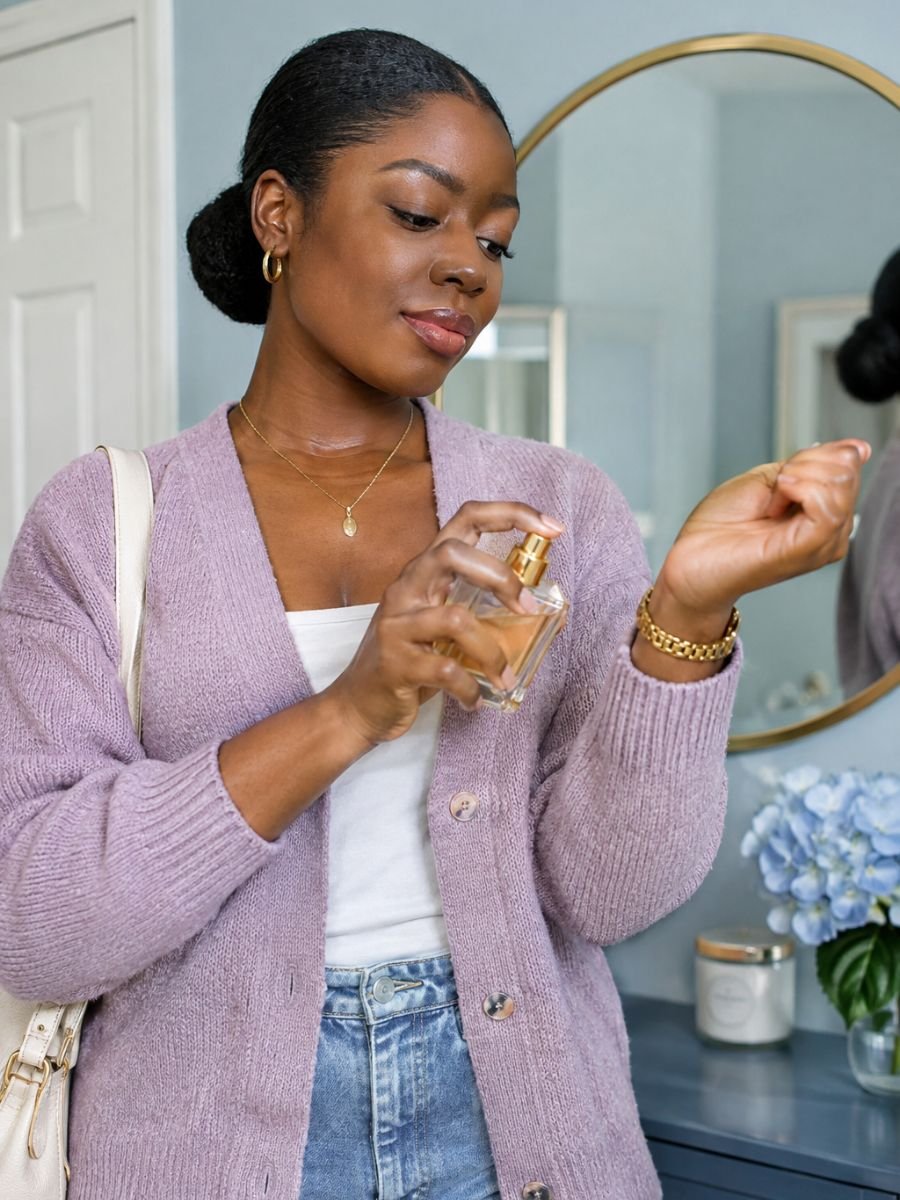
Now think about what happens when you spray perfume onto your skin.
Your body continuously produces heat.
That warmth helps fragrance molecules enter the air, which is part of the reason you can smell your perfume after applying it.
But evaporation also gradually reduces the amount of fragrance remaining on the surface.
The process is influenced by the properties of the fragrance molecules, the temperature, and the surrounding conditions.
Clothing that's hanging in a wardrobe or resting on a chair may be cooler than your skin.
Under those conditions, some fragrance materials may evaporate more slowly.
This doesn't mean perfume always lasts longer on fabric simply because fabric is cooler.
The chemical interactions between the fragrance and textile matter, too.
And clothing worn close to your body can become quite warm.
Still, differences in temperature and material properties help explain why a fragrance may behave differently on a scarf than it does on your wrist.
Sometimes that beautiful scent remains quietly in the fibers until you pick up the garment or move it.
And suddenly, there it is again.
3. Your Skin Has More Variables Than Your Clothing
There's another reason the comparison isn't always straightforward.
Skin characteristics vary from person to person.
Hydration, surface texture, and water loss can influence how certain fragrance molecules evaporate.
A 2025 study published in the International Journal of Cosmetic Science examined the evaporation of eight fragrance molecules on the skin of ten volunteers.
Researchers found differences associated with skin hydration, surface characteristics, and the properties of the fragrance molecules themselves.
The study compared skin with an inert glass surface, not clothing, so it doesn't establish that fabric will always retain perfume longer.
But it helps explain why perfume behaves differently on living skin than it does on other surfaces.
Your daily routine can also make a difference.
Perfume applied to your wrists may be affected by handwashing, friction from sleeves, or perspiration.
A fragrance on a scarf hanging in your wardrobe isn't experiencing those same conditions.
So the amount of scent remaining can become quite different over time.
Do Certain Fabrics Hold Perfume Longer Than Others?
Now for something worth considering before you start spraying your entire wardrobe.
Not all fabrics retain fragrance in the same way.
The type of fiber, fabric construction, and individual fragrance materials can all influence the result.
And the research is more complicated than simply saying natural fibers are always better than synthetic ones.
4. Cotton and Polyester Can Retain Fragrance Differently
Cotton and polyester are two of the most common materials used in clothing.
But they have different chemical properties.
Cotton is primarily made from cellulose, a material that interacts readily with water.
Polyester is a synthetic material that's generally less attracted to water.
These differences can influence how fragrance molecules interact with each fiber.
In the 2025 textile fragrance study, researchers found that cotton and polyester retained perfume materials differently during the washing and rinsing process.
Polyester showed greater retention of certain fragrance materials under some conditions, while cotton showed different deposition behavior during rinsing.
Another 2025 study published in Science of the Total Environment examined how seven semi-volatile organic compounds accumulated in nine different textiles.
Researchers found substantial differences between fabric types, with cotton, certain blends, and nylon-elastane materials showing different retention characteristics from polyester.
One of the tested compounds was galaxolide, a synthetic musk used in fragrance applications.
However, the researchers weren't comparing the perceived longevity of finished perfumes sprayed onto garments.
Their findings show that textile chemistry matters, but they don't establish a universal ranking of the best fabrics for perfume.
So if someone tells you that cotton always holds fragrance longer than polyester—or the other way around—that advice is too simplistic.
The specific perfume and fabric both matter.
5. Wool and Textured Fabrics May Hold Scent Differently
Perhaps you've noticed perfume lingering on a wool sweater or a favorite winter scarf.
Textured fabrics have many fibers and surfaces where fragrance materials may settle.
The construction of a textile can influence how substances are retained and released.
A 2025 review published in Textile Research Journal discussed how fiber type, fabric structure, and environmental conditions influence odor retention in clothing.
Much of that review concerned body odor rather than fine fragrance, so its findings shouldn't be treated as a direct comparison of perfume longevity on wool, cotton, and polyester.
Still, it reinforces the importance of fabric construction.
A thick, textured sweater may interact with fragrance differently from a thin, smooth blouse.
And even two garments made from the same fiber can behave differently because of their weave, finish, or construction.
That's part of the reason there isn't one perfect fabric for every perfume.
There's also a practical consideration.
Wool and other fine textiles can be delicate, expensive, or difficult to clean.
So although you may enjoy the scent lingering on a favorite sweater, it doesn't necessarily mean spraying perfume directly onto that sweater is the safest choice.
Enjoying That Beautiful Trace of Perfume on Your Clothes

You may have noticed something else about perfume on clothing.
Sometimes it doesn't smell quite the same as it does on your skin.
Perhaps the opening seems more noticeable.
Or maybe a warm, musky quality remains on your scarf long after the brighter notes have disappeared.
There's a reason the fragrance may develop differently.
6. The Surface Influences How a Fragrance Develops
Perfume is made from aromatic materials with different physical and chemical properties.
Some evaporate relatively readily, while others remain on a surface longer.
When these materials interact with skin or fabric, their relative release into the air can change.
As a result, you may experience a different balance of fragrance notes.
For example, a perfume with a bright citrus opening and a warm woody base may gradually become softer on skin.
On fabric, certain ingredients may be retained and released differently, changing which parts of the composition remain noticeable.
But there's no reliable rule saying that top notes always last longer on fabric or that a perfume will smell exactly the same on clothing throughout the day.
The result depends on the perfume and the material.
That's why it's helpful to experience a fragrance on your skin before deciding whether you love it.
A perfume that smells beautiful on a test strip or sweater may develop differently once it's applied to your body.
And sometimes, that difference is part of the pleasure of discovering a new scent.
Can Perfume Really Stay on Clothes for Days?
If you've ever noticed fragrance on a jacket you haven't worn for several days, you know that traces of scent can sometimes remain surprisingly long.
But how long should perfume actually last on clothing?
There's no universal answer.
Some fragrance materials may remain detectable for hours, while others can persist longer under favorable conditions.
The type of fabric, perfume composition, amount applied, temperature, airflow, and storage conditions all influence the result.
It's also important to distinguish between fragrance that can be detected by scientific instruments and fragrance that's strong enough for someone to smell.
A laboratory may identify tiny amounts of a compound long after the scent has become imperceptible to a person.
That doesn't mean your clothing will smell strongly perfumed for days or weeks.
Similarly, if your favorite coat retains a trace of fragrance until the following weekend, you shouldn't assume every perfume will behave that way.
The important thing is that some textiles can retain fragrance materials long enough for you to notice them well after the scent on your skin has softened.
And that lingering trace can be one of the loveliest little surprises in a fragrance routine.
Should You Spray Perfume Directly Onto Your Clothes?
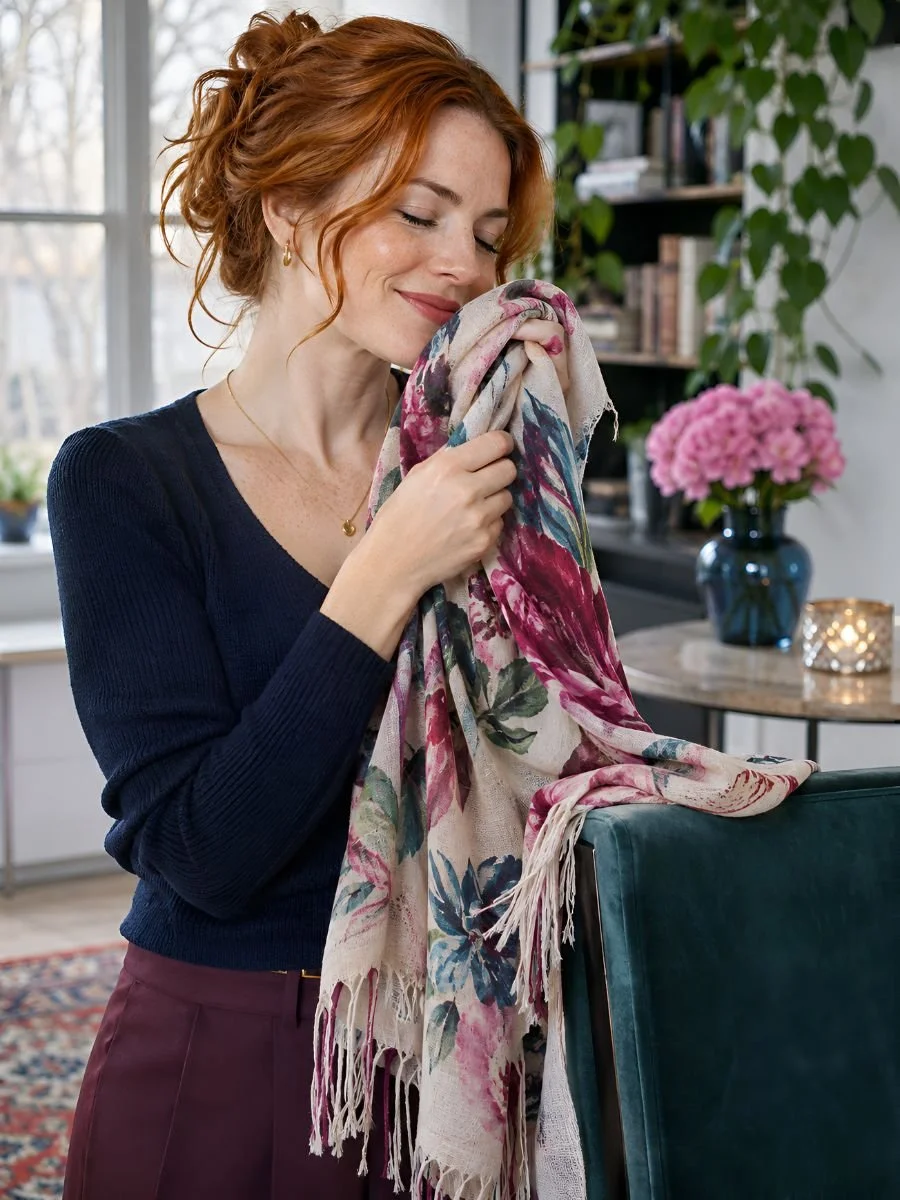
Now we come to an important question.
If perfume can linger longer on fabric, should you start spraying your clothing instead of your skin?
Not necessarily.
Although fabric can retain fragrance beautifully, perfume may also leave marks or damage certain materials.
And when you've invested in a beautiful blouse, scarf, or dress, protecting the garment comes first.
7. Perfume Can Stain Certain Fabrics
Many perfumes contain alcohol and fragrance materials that may leave visible marks on clothing.
Some formulas also contain colored ingredients or other substances that can affect delicate materials.
According to Sisley Paris's fragrance application guidance, perfume may stain clothing, particularly delicate fabrics such as silk and satin or light-colored garments.
The fragrance house recommends taking care when applying perfume near clothing.
The House of Creed also advises testing perfume on an inconspicuous area before applying it to fabric, warning that visible wetness from a spray may result in staining.
That's worth remembering when you're wearing something special.
Silk, satin, leather, suede, delicate finishes, and garments with unusual dyes or embellishments deserve particular caution.
Even if a fabric holds fragrance beautifully, it may not tolerate direct perfume application.
And a perfume stain can be much more difficult to remove than a fading fragrance is to refresh.
8. How to Enjoy Perfume on Clothing More Safely
If you enjoy the idea of a little fragrance lingering on your clothes, begin by checking whether the perfume and garment are suitable.
A few sensible precautions can help:
Check the garment's care label and avoid directly spraying delicate, valuable, or easily stained materials.
Test the perfume on a small, hidden area of a suitable fabric before applying it more widely.
Allow the test area to dry completely and check for discoloration or marks.
If the fabric tolerates the fragrance, use a light mist rather than saturating one spot.
Let the fragrance dry before wearing or storing the garment.
Remember that a patch test reduces uncertainty but cannot guarantee that a fragrance will never leave a mark.
If you're unsure, the safest choice is to apply your perfume to your skin and let it dry before getting dressed.
You can also look for fragrance products specifically intended for fabrics, following their instructions and checking which materials they're suitable for.
There's no need to risk an expensive garment simply to make a perfume last a little longer.
Is It Better to Wear Perfume on Skin or Clothing?

Is It Better to Wear Perfume on Skin or Clothing?
The answer depends on what you want from your fragrance.
If you enjoy the way a perfume develops on your body, skin application is a natural place to begin.
Your warmth and individual skin characteristics contribute to the way the scent is released.
If you're interested in longer-lasting traces of fragrance, suitable fabric may offer a different experience.
But clothing isn't automatically the better option.
There's the possibility of staining, and some fabrics may retain fragrance differently from others.
And remember that fragrance remaining on clothing can also be inconvenient when you want to wear a different perfume.
That beautiful vanilla from yesterday may still be lingering on your cardigan when you've decided to wear a fresh floral today.
The two scents might complement one another beautifully.
Or they may not.
Sometimes a lingering fragrance is a pleasure, and sometimes you'd rather begin with a clean slate.
For everyday perfume wear, there's nothing wrong with applying fragrance to your skin and allowing the occasional trace to transfer naturally to your clothing.
You don't need to spray every garment to enjoy a beautiful scent.
The Parlor Notes: A Simple Way to Compare Perfume on Skin and Fabric
If you're curious about how your favorite fragrance behaves on different surfaces, try a small comparison at home.
This is a simple observation exercise rather than a scientific test, but it may help you understand why your perfume seems to linger on certain materials.
Choose a perfume you already know well.
Select a clean, inexpensive fabric sample that's safe to test with fragrance. Avoid using delicate or valuable clothing.
Test a hidden section for staining before proceeding.
On another day, apply a modest amount of perfume to the fabric and your normal amount to clean skin.
Notice how the fragrance smells when first applied.
Check both surfaces a few hours later without repeatedly sniffing them throughout the day.
If the fabric remains suitable and unstained, see whether a trace of fragrance is detectable later or the following day.
Pay attention to more than whether you can smell the perfume.
Does the scent seem softer on one surface?
Does it develop differently?
Is a particular part of the fragrance more noticeable on fabric?
You may discover that your favorite perfume remains detectable on cotton longer than it does on your wrist.
Or perhaps the difference is much smaller than you expected.
Remember that your nose can become accustomed to a familiar scent, and the amount of perfume deposited on each surface may not be identical.
So this comparison won't give you a precise measurement of fragrance longevity.
But it can offer a little insight into how your perfume behaves.
And that may help you decide how you enjoy wearing it most.
Enjoying That Beautiful Trace of Perfume on Your Clothes
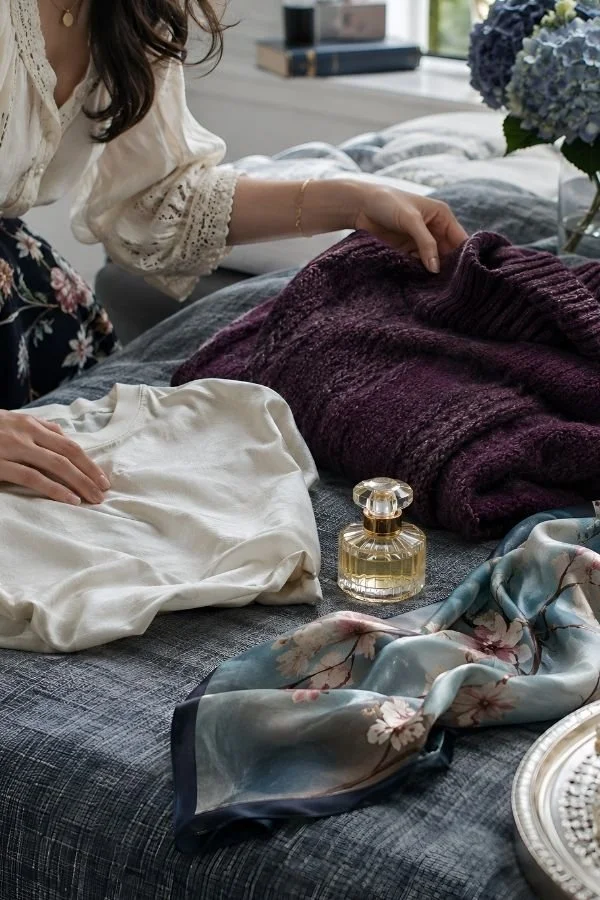
Perhaps one of the most charming things about fragrance is the way it sometimes surprises us.
A perfume you wore yesterday may greet you again when you pick up your favorite sweater.
A warm, comforting scent may linger on a scarf, reminding you of a lovely evening.
Or a soft floral may leave the faintest impression on a jacket long after you've forgotten which perfume you wore.
Those little moments are part of what makes wearing fragrance so personal.
And now you know that there's real chemistry behind them.
Fabric fibers can retain fragrance materials and release them differently from living skin.
Temperature, textile construction, molecular properties, and everyday activities all influence how long those materials remain detectable.
But not every fabric behaves the same way, and longer fragrance retention doesn't automatically make clothing the best place to spray perfume.
Sometimes the most sensible approach is simply to enjoy your fragrance on your skin, protect your clothing, and appreciate the occasional scent that lingers.
If you decide to experiment with fabric application, do so thoughtfully.
Choose suitable materials, test carefully, and remember that your favorite clothes deserve as much consideration as your favorite perfumes.
After all, a beautiful fragrance should add pleasure to your day, not leave you worrying about a stain on your blouse.
And there's something especially lovely about discovering that a little trace of yesterday's perfume is still waiting for you.
Before You Leave the Parlor 💕… Don't slip out without signing the guest book — just drop a note in the comments below.
Have you ever noticed your favorite perfume lingering on a sweater, scarf, or jacket long after it faded from your skin?
Tell us which fragrance it was and what you were wearing—we would love to hear about your experience.
Beauty Starts at the Parlor™.
