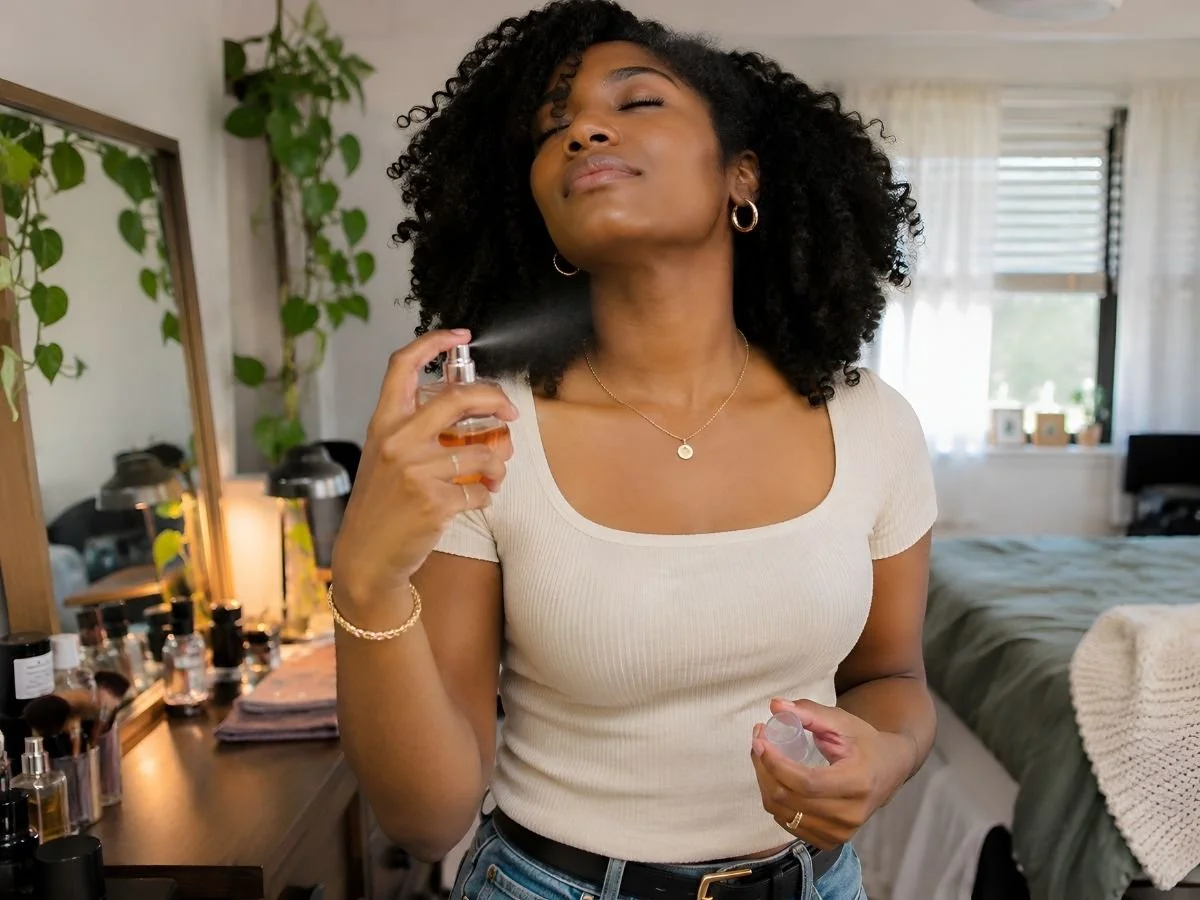
Your perfume smells absolutely beautiful when you first spray it. It surrounds you with fragrance, makes a lovely first impression, and then, an hour or two later, seems to vanish. But where did all that beautiful scent go? Here's why perfume projection changes throughout the day—and what you can do when your favorite fragrance becomes a little too quiet.
You know that wonderful moment when you first spray on a beautiful perfume?
Perhaps it's a sparkling floral with fresh bergamot, a warm vanilla with a little amber, or an elegant fragrance that seems to wrap around you like a soft cashmere sweater.
You catch that first lovely burst of scent, fasten your earrings, and finish getting dressed.
The perfume is gorgeous.
It's noticeable without having to bring your wrist anywhere near your nose. You can smell it as you move around, and you leave the house feeling perfectly put together.
Then something rather disappointing happens.
An hour or two later, that beautiful cloud of fragrance seems to have disappeared.
You wonder whether you imagined how strong it was in the first place.
Perhaps you didn't apply enough.
Or maybe you've purchased another perfume that makes a wonderful entrance but doesn't know how to stay.
Before you blame your fragrance, there's something worth understanding.
Perfume often projects more strongly immediately after application because its more volatile aromatic materials are being released into the air. As those materials evaporate, the fragrance changes, and its projection may become softer. Your nose can also grow accustomed to the scent, making the change seem even more dramatic.
In other words, your perfume may not have disappeared at all.
It may simply have stopped announcing itself.
Let's explore why that happens, what recent fragrance research reveals, and how to tell whether your perfume is genuinely fading or just becoming a little more discreet.
Why Does Perfume Smell So Strong When You First Spray It?

There's a reason that first spritz can feel so impressive.
When perfume leaves the atomizer, it enters the air as a fine spray of droplets.
In a typical alcohol-based perfume, the alcohol begins evaporating rapidly, while fragrance materials are released into the surrounding air.
That initial application creates a noticeable burst of aroma.
But the strength of that opening isn't necessarily a preview of how the perfume will behave throughout the day.
1. The First Spray Releases Some of the Most Noticeable Fragrance Materials
Perfumes contain aromatic materials with different physical and chemical properties.
Some evaporate readily, allowing them to reach your nose quickly.
Others are released more gradually.
This is part of the familiar distinction between top, heart, and base notes.
The top notes create much of the perfume's initial impression.
Think of the sparkle of lemon, the brightness of bergamot, or the refreshing quality of certain green and aromatic notes.
These impressions can be wonderfully expressive when you first apply your perfume.
But many of the materials responsible for them are relatively volatile.
As they evaporate, their contribution to the fragrance decreases.
A July 2026 study published in the Flavour and Fragrance Journal examined how selected top and heart-note materials were released from an alcoholic perfume formulation.
The researchers demonstrated that fragrance release changes over time and that modifying a formulation can alter how long certain volatile materials remain detectable in laboratory measurements.
The study investigated a model perfume rather than the everyday wear of multiple commercial fragrances on human skin.
Still, it provides useful evidence for why the most noticeable part of a fragrance may not remain equally strong after application.
And that brings us to something many perfume lovers discover only after they've spent a little time wearing fragrance.
The opening isn't the whole perfume.
2. Your Perfume's Heart and Base Notes May Be Much Softer
Imagine a fragrance that opens with bright orange blossom and sparkling citrus before settling into creamy musk and sandalwood.
The first few minutes may be lively and expressive.
You can smell the fragrance around you without trying.
But as those brighter materials evaporate, the softer elements become more noticeable.
The perfume begins to feel warmer, smoother, or more intimate.
It's still there, but its personality has changed.
This stage is often called the dry-down.
According to The Perfume Society's explanation of fragrance notes, top notes create the opening impression, while heart and base notes contribute to the fragrance's developing and lasting character.
Of course, not every perfume follows a perfectly separated sequence.
Some fragrances are designed to maintain a relatively consistent character, while others change noticeably throughout wear.
But the underlying principle remains important.
A perfume's most sparkling opening materials may not be the ones responsible for its lasting scent.
So when that initial burst disappears, you may simply be experiencing the next part of the fragrance.
And sometimes, that quieter stage is where its real elegance begins.
Your Perfume May Have Lost Projection Without Losing Longevity

Here's where perfume terminology becomes especially useful.
Have you ever noticed that your fragrance no longer surrounds you, but you can still smell it when you bring your wrist toward your nose?
That's an important clue.
Your perfume may have lost projection while retaining longevity.
3. Projection and Longevity Aren't the Same Thing
Projection describes how far a fragrance travels from your skin into the surrounding air.
Longevity describes how long the fragrance remains detectable after application.
These two qualities are related, but they're not interchangeable.
Imagine wearing a beautiful floral perfume to lunch.
When you first arrive, the fragrance seems to float around you.
A friend sitting nearby may notice it without leaning toward you.
A few hours later, you can still detect the perfume on your wrist, but it no longer reaches as far into the surrounding air.
The perfume hasn't completely disappeared.
Its projection has become softer.
And there's nothing unusual about that.
Some perfumes have a striking opening followed by a more intimate dry-down.
Others maintain a noticeable presence for longer.
The difference depends partly on the fragrance's composition and how its aromatic materials are released.
4. A Long-Lasting Perfume Can Become a Skin Scent
Perhaps you've encountered the term skin scent.
A skin scent is a fragrance, or a stage of a fragrance, that remains noticeable mainly at close range.
Instead of surrounding you with a large cloud of scent, it stays close to your body.
You may notice it when you bring your wrist toward your nose or when someone comes near enough to detect it.
Some perfume lovers absolutely adore this effect.
There's something beautiful about a fragrance that doesn't announce itself to everyone in the room.
But if you purchased a perfume expecting strong projection throughout the day, that softer stage may feel disappointing.
And this is why it's worth paying attention to more than the first spray when shopping for fragrance.
A perfume can smell wonderfully strong during its opening and still settle into a delicate skin scent relatively quickly.
That doesn't necessarily mean it has poor longevity.
It means the fragrance wears more quietly after its initial impression.
Your Nose May Be Making the Change Seem More Dramatic

Now here's something fascinating.
Sometimes your perfume's projection really has decreased.
But your sense of smell may also be contributing to how dramatically you notice that change.
Have you ever walked into a room filled with the fragrance of fresh flowers?
At first, the scent is unmistakable.
After spending some time there, you hardly notice it.
The flowers haven't necessarily stopped releasing their aroma.
Your nose has simply become less responsive to that familiar scent.
A similar process can happen when you're wearing perfume.
5. Olfactory Adaptation Can Make Your Perfume Seem to Disappear
This process is called olfactory adaptation, often described as becoming nose-blind.
With continued exposure to an odor, your sensitivity to it can decrease.
A 2026 study published in Building and Environment examined how people responded to prolonged exposure to lemon and acetic acid odors.
Researchers found that perceived odor intensity decreased during continued exposure.
They also observed that sensitivity recovered after participants left the scented environment.
The study wasn't conducted with people wearing commercial perfumes, so it doesn't establish exactly how quickly someone becomes accustomed to a particular fragrance.
But it demonstrates that our perception of an odor can become weaker even when exposure continues.
And that matters when you're judging your perfume.
You may notice its bold opening because the fragrance is new to your nose.
As you continue wearing it, your sensitivity may decrease while the perfume's more volatile materials are also evaporating.
The result?
Your fragrance seems to go from wonderfully noticeable to almost nonexistent.
But those two processes—fragrance evaporation and changes in your own sensitivity—can happen together.
The Pretty Skin Parlor™ advice: Before reaching for another spray, consider whether your perfume has genuinely faded or whether you've simply become accustomed to smelling it.
If someone else can still detect your fragrance comfortably while you barely notice it, your own scent adaptation may be contributing.
Does Your Skin Affect How Quickly Perfume Loses Projection?
We've talked about the perfume and your nose.
But there's another part of the picture.
Your skin.
Fragrance doesn't behave identically on every surface, and researchers are learning more about how individual skin characteristics influence evaporation.
6. Skin Hydration and Surface Characteristics May Play a Part
A 2025 study published in the International Journal of Cosmetic Science investigated the evaporation of eight fragrance molecules from the skin of ten volunteers.
The researchers measured several skin characteristics, including hydration, surface roughness, and water loss.
They found that these characteristics influenced the evaporation of certain fragrance materials.
However, the effects weren't identical for every molecule.
The study was small, and it didn't establish exactly how long finished commercial perfumes would project on different people.
But it helps explain why a fragrance's release from the skin can vary.
If your skin tends to be dry, applying a fragrance-free moisturizer before perfume may be worth trying.
Just remember that research has not established that body lotion will make every perfume project more strongly or for longer.
Moisturizing can be a sensible part of your skincare routine without being a guaranteed solution for fragrance performance.
7. Your Surroundings Can Change How You Experience Projection
Think about wearing the same fragrance in two very different situations.
On one day, you're getting ready in a quiet bedroom.
On another, you're walking outdoors on a warm, breezy afternoon.
The perfume may feel quite different.
Temperature and airflow influence how fragrance materials evaporate and disperse.
Warmth can encourage evaporation, making some fragrance materials more noticeable initially.
Air movement can also carry scent away from your body.
That doesn't necessarily mean perfume will last longer or project farther under warmer conditions.
In fact, faster evaporation may change how quickly some materials are depleted.
That's why your fragrance may seem expressive during one part of the day and much softer during another.
And it helps explain why someone else's experience with a perfume isn't always a reliable prediction of your own.
Can You Make Your Perfume Project Strongly for Longer?
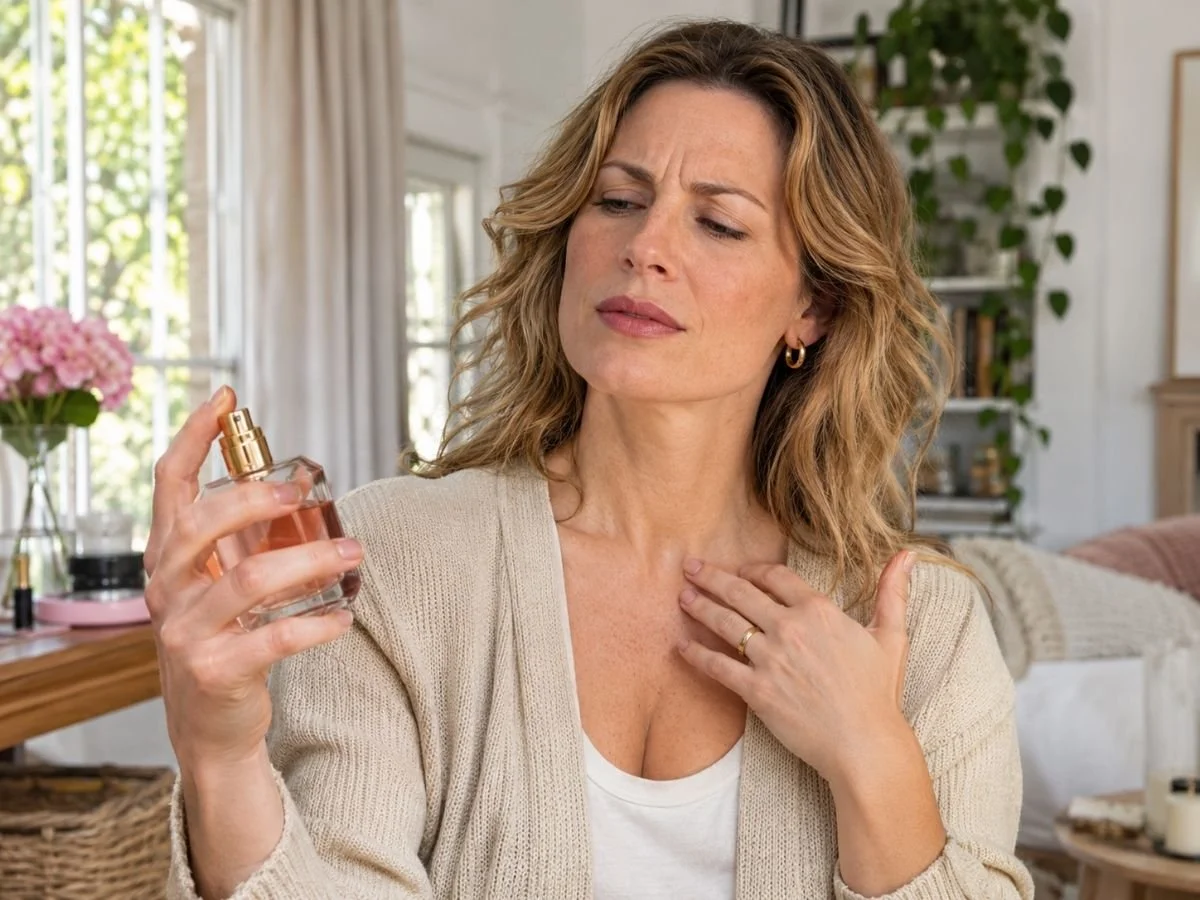
Can You Make Your Perfume Project Strongly for Longer?
Now for the question you may really be wondering about.
If your perfume makes a beautiful entrance but becomes quiet too quickly, can you do anything about it?
There are a few things worth trying.
But first, it's important to understand that a perfume's projection is largely influenced by its formulation.
You can't reliably transform every soft fragrance into a powerhouse simply by applying it differently.
8. Choose a Fragrance With the Performance You Actually Want
If strong projection is important to you, pay attention to how a perfume behaves after its opening.
Don't make your decision based only on the first five minutes.
That sparkling first impression may be absolutely gorgeous, but it may not represent the fragrance's presence several hours later.
Instead, try the perfume on your skin and wear it through an ordinary day.
Notice how far the fragrance seems to extend once the opening has settled.
Does it remain noticeable around you?
Or does it become a delicate scent that stays close to your skin?
Neither is necessarily better.
But one may suit your preferences more than the other.
And don't assume that choosing an Eau de Parfum instead of an Eau de Toilette will automatically solve the problem.
A higher fragrance concentration may contribute to longer wear, but projection depends on the materials and formula, not concentration alone.
9. Don't Assume More Sprays Will Solve the Problem
It's tempting to believe that if your perfume becomes soft after an hour, you simply didn't apply enough.
But that's not always the case.
Adding more fragrance can increase the amount of scent around you, particularly soon after application.
However, it doesn't necessarily change the way the individual fragrance materials evaporate.
And if your nose has become accustomed to the perfume, additional sprays may not restore that beautiful first impression for you.
Meanwhile, people around you may find the fragrance considerably stronger than you realize.
A modest afternoon refresh can be perfectly reasonable when a perfume has genuinely faded.
But repeatedly spraying simply because you can no longer smell it may leave you wearing more fragrance than intended.
Especially in offices, restaurants, and other shared spaces.
Sometimes a little restraint is much more elegant than another generous spritz.
10. Remember That Fragrance Formulation Makes a Difference
Here's an interesting development in modern perfumery.
Fragrance researchers are investigating ways to influence how aromatic materials are released over time.
The 2026 Flavour and Fragrance Journal study examined a polymer-based fixative added to a model alcoholic perfume.
A fixative is a material or formulation component used to influence how fragrance ingredients are released or retained.
The researchers found that adding the tested fixative changed the release patterns of selected top and heart-note materials.
Interestingly, a moderate concentration of the additive performed better than a higher concentration for several measured compounds.
The results illustrate that fragrance release isn't simply a matter of adding more ingredients.
The formulation itself matters.
However, the study doesn't establish that every commercial perfume containing a fixative will project more strongly throughout the day.
Nor does it mean you should attempt to modify a finished perfume at home.
What it does show is that perfumers can influence the release of fragrance materials through careful formulation.
And that helps explain why two perfumes with similar note descriptions may behave quite differently after application.
The Parlor Notes: How to Tell Whether Your Perfume Is Really Losing Projection
If your favorite perfume seems to lose its presence quickly, try this little fragrance experiment before deciding you need something stronger.
Choose a perfume you know well and apply your usual amount to clean, comfortable skin.
Enjoy the opening without repeatedly bringing your wrist toward your nose.
After the first hour, notice whether you can still detect the fragrance around you naturally.
If someone you trust is comfortable helping, ask whether they can detect your perfume at a normal conversational distance.
Later in the day, check whether a softer scent remains close to your skin.
Repeat the observations on another day to see whether you notice a similar pattern.
Here's what you may discover.
If your perfume is still detectable close to your skin but no longer noticeable farther away, its projection may have decreased while its longevity continues.
If someone else can smell your fragrance comfortably while you barely notice it, olfactory adaptation may also be contributing.
And if the scent has become faint to both of you, the fragrance may genuinely have lost much of its detectable intensity.
These observations aren't precise scientific measurements.
Air movement, distance, individual smell sensitivity, and the amount of perfume applied can all influence the results.
But they may help you understand your fragrance better.
And sometimes that's enough to stop you from unnecessarily replacing a perfume you actually love.
Is It Normal for Perfume to Lose Projection After an Hour?
Yes, it can be.
Some perfumes have a very noticeable opening that becomes softer relatively quickly.
Others are designed to maintain a more consistent fragrance presence as they develop.
There's no universal rule saying that a good perfume must project strongly for a particular number of hours.
Projection is also different from quality.
A perfume can be beautifully composed, expensive, and made with carefully selected materials while still having a relatively intimate wearing style.
Likewise, a fragrance with a striking opening isn't necessarily poorly made simply because its projection becomes softer.
The most important thing is whether the perfume behaves the way you want it to.
If you love a fragrance that stays close to your skin, a softer projection may be exactly what you're looking for.
But if you enjoy something more expressive, it's worth sampling fragrances with that characteristic rather than expecting a delicate perfume to become something it isn't.
And remember that projection isn't the only thing worth appreciating.
Sometimes a perfume's loveliest stage arrives after the initial excitement has settled.
Learning to Love the Whole Perfume, Not Just the First Spritz

There's something irresistible about the opening of a beautiful fragrance.
That first sparkling moment can be fresh, romantic, comforting, or wonderfully sophisticated.
It's the part that often makes us fall in love with a perfume in the first place.
But the opening is only one part of the experience.
As the fragrance develops, its character changes.
Some materials evaporate, others become more noticeable, and the scent may settle closer to your skin.
Your own sense of smell can also become accustomed to it.
So when your perfume stops projecting as strongly, it doesn't automatically mean the fragrance has disappeared or that you've purchased something disappointing.
Perhaps the dramatic entrance has simply given way to a quieter, more intimate presence.
If strong projection matters to you, give a perfume enough time to reveal how it behaves beyond the opening.
Notice its character after an hour, throughout the afternoon, and as it settles into its final stages.
And if you discover that your favorite fragrance is naturally soft, there's no reason you can't enjoy it exactly as it is.
The secret is understanding that perfume projection changes throughout wear—and deciding whether those changes suit the experience you're hoping for.
After all, a beautiful perfume doesn't have to remain the loudest thing in the room to make a lasting impression.
Sometimes its most charming moment comes after it has stopped announcing itself and begins to feel like a little part of you.
Before You Leave the Parlor💕…
Don't slip out without signing the guest book — just drop a note in the comments below.
Does your favorite perfume make a beautiful, noticeable entrance and then settle close to your skin, or does it keep projecting for hours?
Tell us which fragrance you're wearing and how its projection changes throughout the day—we would love to hear about your experience.
Beauty Starts at the Parlor™.
