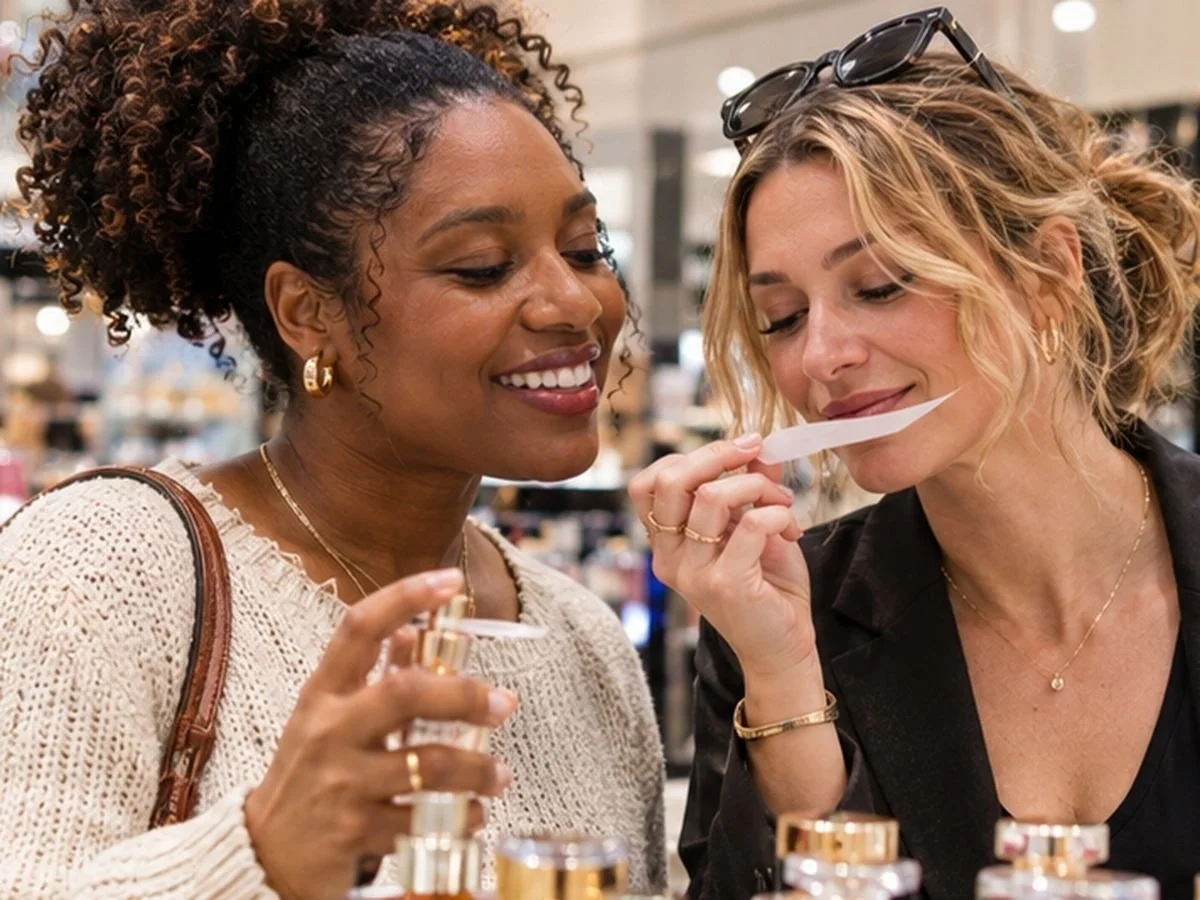
Have you ever fallen in love with a perfume on someone else, only to discover that it smells different or doesn't last nearly as long on your own skin? The fragrance hasn't necessarily changed. Recent research reveals how skin characteristics, fragrance chemistry, and even our sense of smell can influence the way we experience the very same perfume.
You notice a beautiful perfume on a friend.
Perhaps it's an elegant floral with a soft, powdery finish, a warm vanilla that leaves a lovely trail, or a sophisticated fragrance with just the right touch of musk.
Naturally, you ask what she's wearing.
She tells you the name, and you're delighted to discover that it's a perfume you've been meaning to try.
You purchase a bottle, spray it on your skin, and wait for that same gorgeous fragrance to appear.
But something isn't quite right.
The perfume smells sharper than you remember. Perhaps the sweetness is more noticeable, the floral notes seem softer, or the fragrance that lingered beautifully on your friend becomes faint on you after a few hours.
Same perfume. Same bottle.
So why are you having such different experiences?
You've probably heard someone explain this by saying that perfume reacts with everyone's body chemistry.
There's some truth behind the idea that our individual characteristics influence fragrance performance, but the science is more specific than that familiar explanation suggests.
The same perfume can perform differently on different people because skin characteristics can influence how fragrance molecules evaporate, while individual differences in smell perception affect how strongly those molecules are detected. Application habits and environmental conditions can also change the experience.
And here's something particularly interesting.
The perfume may not actually be performing worse on you. You and your friend may simply be experiencing it differently.
Let's explore what recent research reveals about why the same fragrance can smell, project, and last differently from one person to another.
What Does Perfume Performance Actually Mean?
Before we talk about skin chemistry, it helps to understand what perfume lovers mean when they discuss a fragrance's performance.
A perfume can perform beautifully in one way and quite differently in another.
There are three important qualities to consider.
Longevity: How Long the Fragrance Remains Detectable
Longevity describes how long a perfume can still be smelled after application.
Some fragrances become faint relatively quickly, while others remain noticeable for many hours.
But longevity doesn't tell you how strong a perfume smells throughout that time.
A fragrance may remain detectable close to your skin long after its initial intensity has faded.
Projection: How Far the Fragrance Travels
Projection describes how far a perfume's scent extends into the surrounding air.
A fragrance with noticeable projection may be detected by someone standing nearby.
A softer fragrance may remain much closer to your skin.
And there's an important distinction: a perfume that lasts a long time doesn't necessarily project strongly.
Scent Development: How the Perfume Changes
A perfume's character also changes as its aromatic materials evaporate.
The bright opening may give way to softer florals, woods, or musks.
This gradual development is often called the dry-down.
When someone says a perfume smells completely different on them, they may be noticing differences in which parts of the fragrance are most apparent.
Understanding these three qualities helps explain why two people can have different impressions of the same perfume without either person being wrong.
Your Skin Can Influence How Perfume Evaporates
Now let's look at one of the most important scientific explanations.
Your skin isn't an inactive surface.
It contains water, natural lipids, and a protective outer layer with its own physical and chemical characteristics.
Those characteristics can influence how fragrance materials behave after application.
1. A 2025 Study Found Measurable Differences Between People's Skin
One of the most directly relevant studies was published in June 2025 in the International Journal of Cosmetic Science.
The study, Exploring the Impact of Fragrance Molecular and Skin Properties on the Evaporation Profile of Fragrances, investigated how fragrance molecules evaporated from the skin of ten volunteers.
Researchers applied a mixture containing eight fragrance molecules and examined how those materials were released from different participants' skin.
They measured characteristics including skin hydration, surface roughness, and transepidermal water loss.
Transepidermal water loss refers to water that passes through the skin and evaporates into the surrounding air.
The researchers found that fragrance evaporation varied between participants.
They also identified relationships between certain skin characteristics and the behavior of individual fragrance molecules.
However, not every molecule responded in the same way.
More volatile compounds were particularly influenced by surface roughness, while some less volatile materials were associated with hydration and water loss.
This is an important finding because commercial perfumes contain many different aromatic materials.
A change in how one ingredient evaporates doesn't necessarily mean every other ingredient will behave similarly.
The researchers also acknowledged that their study was small and that larger investigations are needed.
Still, the results provide evidence that individual skin characteristics can influence fragrance release.
And that gives us a more meaningful explanation than simply saying a perfume works differently because of body chemistry.
2. Skin Hydration May Influence Certain Fragrance Materials
You've probably heard that perfume lasts longer on moisturized skin.
The 2025 research provides some support for a relationship between skin hydration and fragrance evaporation.
But the findings need to be understood carefully.
The researchers examined naturally occurring differences in skin hydration.
They didn't conduct a trial to determine whether applying body lotion before perfume would make a finished commercial fragrance last longer.
So while hydration appears relevant, we cannot conclude that moisturizing will automatically increase the longevity of every perfume.
For some fragrance materials, greater hydration may influence how readily they leave the skin.
For others, different properties may be more important.
If your skin tends to be dry, trying a fragrance-free moisturizer before applying perfume is a reasonable experiment.
Just don't expect a body lotion to transform every delicate fragrance into one that lasts all day.
3. Oily Skin Doesn't Automatically Mean Better Perfume Performance
Another familiar claim is that perfume always lasts longer on oily skin.
The explanation usually suggests that fragrance molecules cling to natural skin oils.
Certain aromatic materials can interact with lipids, but that doesn't establish that everyone with oily skin will experience better perfume longevity.
In the 2025 study, sebum wasn't identified as one of the strongest factors associated with differences in fragrance evaporation.
And the researchers examined the forearm, which has different skin characteristics from areas such as the face.
That means we shouldn't use the findings to make universal claims about oily or dry skin.
Your skin's behavior depends on several characteristics working together.
The perfume's formula matters, too.
There isn't one ideal skin type that guarantees every fragrance will perform beautifully.
Why the Same Perfume Can Smell Different on Two People

Now for something especially interesting.
When you notice a perfume smelling sweeter, sharper, softer, or more musky on someone else, the difference may involve both the fragrance's release from the skin and the way each person perceives it.
Our sense of smell isn't identical.
4. People Have Different Sensitivities to Odors
A 2026 study published in Chemical Senses investigated how individuals perceived six different odor molecules.
Researchers studied 41 participants and examined ratings of odor intensity and other perceptual qualities alongside physiological responses.
The results showed that both the odor itself and individual response patterns influenced perception.
Some aspects of the experience varied considerably between participants.
The study wasn't designed to measure commercial perfume longevity.
But it demonstrates an important principle: people can perceive the same odor differently even under controlled conditions.
Consider a perfume containing a beautiful combination of floral, woody, and musky materials.
One person may find the musky quality particularly noticeable.
Another may focus on the floral character.
That doesn't automatically mean the perfume has developed into an entirely different formula on their skin.
Their perception of the fragrance may be contributing to the difference.
5. Your Sense of Smell Is More Individual Than You Might Realize
A larger 2025 study published in iScience investigated odor perception among 909 people living in 16 regions around the world.
Researchers examined several dimensions of perception, including pleasantness and intensity.
They found broad similarities in how people perceived odors, alongside measurable differences between participants and regions.
Interestingly, odor intensity showed more regional variation than perceived pleasantness.
The study didn't establish that people from a particular region will smell perfume more strongly or that geography determines perfume longevity.
Instead, it helps demonstrate that odor perception has both shared and individual characteristics.
And that's worth remembering when comparing your experience with someone else's.
If a friend tells you her perfume smells strong after eight hours, that describes what she perceives.
It doesn't necessarily provide an objective measurement of how much fragrance remains on her skin.
Similarly, if you stop noticing your perfume after a few hours, it doesn't automatically mean every trace has disappeared.
Sometimes the difference involves the person smelling the fragrance rather than the fragrance itself.
The Perfume Formula Also Influences What You Experience
Skin and smell perception aren't the only factors involved.
The fragrance's actual composition plays an essential role in how it develops and how long its materials remain detectable.
6. Fragrance Molecules Don't All Behave the Same Way
Perfume contains aromatic materials with different physical and chemical properties.
Some are relatively volatile, meaning they evaporate readily.
Others evaporate more slowly.
That's part of the reason perfume can open with sparkling citrus and gradually settle into a warm woody or musky fragrance.
But the interaction doesn't end with evaporation.
Some materials are more attracted to oily environments, while others interact differently with water and other substances.
The 2025 skin evaporation study found that these molecular properties helped explain why fragrance materials behaved differently between participants.
That means the same perfume can release its ingredients at somewhat different rates on different skin surfaces.
In principle, this could change the balance of what reaches the nose at a particular moment.
However, the study measured fragrance molecules rather than conducting a full sensory comparison of how finished perfumes smelled on each participant.
So while the findings offer a scientific explanation for possible differences in scent development, they don't prove that skin chemistry changes every perfume's character in a predictable way.
7. Perfume Formulation Can Influence How Fragrance Is Released
Recent research has also examined how perfume ingredients can be formulated to influence their release.
A July 2026 study published in the Flavour and Fragrance Journal investigated a polymer-based fixative designed to modify the release of certain fragrance materials.
A fixative is a formulation component that can influence how quickly particular aromatic materials are released or retained.
Researchers found that the tested additive changed the release of selected top and heart notes in a model alcoholic perfume.
The results depended on the formulation and concentration used.
This research doesn't tell us how the same commercial perfume will perform on every person.
But it illustrates why a fragrance's composition and formulation deserve as much attention as the skin it's applied to.
Perfume performance is influenced by the materials themselves, their interactions, and the conditions under which they're released.
That's a much more complicated process than simply deciding that one person's skin holds fragrance better than another's.
Your Daily Routine Can Make a Difference
Sometimes the explanation is surprisingly ordinary.
Two people may wear the same perfume but apply it differently or spend their days in very different environments.
And that can influence how much fragrance remains noticeable.
8. Application Areas and Everyday Activities Matter
Imagine you and a friend both apply the same perfume before leaving the house.
You spray your wrists.
Throughout the day, you wash your hands frequently, wear long sleeves, and move your arms against your clothing.
Your friend applies her fragrance to an area that experiences less washing and friction.
By the afternoon, the perfume remaining in those application areas may be different.
Not necessarily because her skin chemistry is better suited to the fragrance.
But because your application areas have experienced different conditions.
Washing can remove fragrance materials from the skin.
Contact with clothing can also transfer or disturb them.
If your perfume tends to fade quickly from your wrists, try applying it to another comfortable area that isn't washed as frequently.
The inner elbows may be worth considering, depending on your clothing and daily routine.
Avoid irritated or broken skin, and allow your perfume to dry before dressing.
9. Temperature Can Change the Way a Perfume Behaves
Warmth affects evaporation.
That's part of the reason perfume can seem especially noticeable when applied to warm skin.
But a stronger initial impression doesn't necessarily mean longer wear.
If certain fragrance materials evaporate more readily, their release into the air may increase.
A quiet afternoon indoors may therefore produce a different fragrance experience from a busy day outdoors in warm weather.
Perspiration, airflow, and activity can also contribute to the conditions surrounding the perfume.
There isn't one universal formula that predicts how many hours these differences will add or subtract.
But when comparing perfume performance, it's worth considering whether both people have actually worn the fragrance under similar conditions.
Is It Really All About Body Chemistry?
Perhaps you've heard someone say that a perfume just doesn't agree with their body chemistry.
It's an easy explanation, but the phrase is often used to describe several different things at once.
Your skin has measurable characteristics that can influence fragrance evaporation.
Your body also produces natural odors, which may contribute to the overall scent experience.
And your sense of smell influences how you interpret the fragrance.
But these are different processes.
We shouldn't assume that skin pH alone determines whether a perfume smells sweet, sour, or long-lasting.
We also shouldn't claim that a person's natural body odor will necessarily transform a commercial perfume into something completely different.
Although skin pH and natural skin substances may be relevant to chemical interactions, current research doesn't provide a reliable way to predict an entire perfume's performance from someone's pH or body chemistry alone.
The same caution applies to age and gender.
While some skin characteristics differ between demographic groups, the 2025 fragrance evaporation study involved only ten volunteers.
That's far too small a sample to establish universal rules about which age group or gender will hold perfume longer.
Your individual experience is more useful than relying on broad assumptions.
And if a particular fragrance doesn't behave the way you'd hoped on your skin, there's no reason to think something is wrong with you.
It may simply be a perfume that doesn't provide the scent experience you prefer.
The Parlor Notes: How to Compare the Same Perfume on Two People
If you've ever wondered why a fragrance seems to perform beautifully on a friend but differently on you, there's a simple way to explore the difference.
You won't be able to measure fragrance evaporation scientifically at home, but you can make a more thoughtful comparison.
Try this little fragrance experiment:
Choose one perfume and use the same bottle for both people.
Apply similar amounts to comparable areas of clean, comfortable skin.
Avoid introducing different scented lotions or body oils to the test areas.
Notice the fragrance's opening without repeatedly checking it.
After a few hours, compare how the scent has developed on each person.
If someone who hasn't been continuously exposed to the fragrance is comfortable helping, ask for their impression.
Consider whether one person has washed the application area, spent time outdoors, or experienced more clothing friction.
Pay attention to the character of the fragrance, not just its strength.
Perhaps the floral notes remain more noticeable on one person.
Maybe the musky dry-down seems stronger on another.
Or you may find that the perfume smells quite similar on both of you, but one person stops noticing it sooner.
Remember that even this comparison has limitations.
The number of sprays doesn't guarantee precisely equal amounts of fragrance, and your own sensitivity can influence what you notice.
Still, this simple exercise may help you distinguish differences in how the perfume wears from differences in how each person perceives it.
And that's a useful thing to understand before deciding whether to buy a full bottle.
Should You Change Your Perfume If It Performs Better on Someone Else?
Not necessarily.
If you love the way a fragrance smells on you, there's no reason to abandon it simply because someone else experiences longer wear or stronger projection.
But if you're disappointed with its performance, consider what you'd actually like to change.
Would you prefer the opening to remain noticeable longer?
Do you want a fragrance that stays close to your skin?
Or are you looking for something with greater projection throughout the afternoon?
Those are different preferences, and they may lead you toward different perfumes.
You can also experiment with applying your fragrance to areas that are less frequently washed or rubbed.
If your skin tends to be dry, using a fragrance-free moisturizer before perfume may be worth trying, although research hasn't established that this will extend the longevity of every finished fragrance.
And when shopping for perfume, don't make your decision based entirely on how it smells on someone else.
Ask for a sample if one is available.
Wear it through an ordinary day.
Notice the opening, the dry-down, and how the fragrance behaves several hours after application.
If perfume causes itching, redness, or irritation, stop applying it to your skin. The American Academy of Dermatology identifies fragrance as a common cause of allergic contact dermatitis.
A perfume should feel as lovely to wear as it smells.
Finding a Perfume That Performs Beautifully on You
Perhaps the most interesting thing about perfume is that the experience isn't quite identical for everyone.
The same fragrance may seem bold and expressive on one person, delicate and intimate on another, and noticeably different as the hours pass.
Recent research helps explain why.
Skin characteristics can influence the evaporation of fragrance molecules.
Perfume formulation affects how aromatic materials are released.
Our individual senses of smell influence how strongly we perceive those materials.
And everyday habits can change the conditions under which a fragrance is worn.
But no single factor explains every difference.
That's why there's no scientifically established formula for predicting exactly how a perfume will perform based on your skin type, age, or body chemistry.
If you discover a beautiful perfume on someone else, enjoy the inspiration.
But give the fragrance a chance to introduce itself on your own skin.
You may find that it develops differently from what you expected.
Perhaps the floral notes become softer, the warm base feels more prominent, or the fragrance settles into a delicate skin scent.
And sometimes, that version may be even more beautiful to you.
The important thing is finding a perfume that suits your own preferences rather than expecting it to perform exactly as it does on someone else.
A fragrance doesn't have to smell or last identically on everyone to be worth loving.
And the most satisfying perfume is often the one you enjoy wearing from its first lovely spritz to its final, quiet trace.
Before You Leave the Parlor💕
Don't slip out without signing the guest book — just drop a note in the comments below.
Have you ever loved a perfume on someone else, only to find that it smelled different or performed differently on your own skin?
Tell us which fragrance it was and what you noticed—we would love to hear about your experience.
Beauty Starts at the Parlor™.
